Decide in three questions
1. Is everyone on Switch? If no, none of these work - go to crossplay instead. If yes, continue.
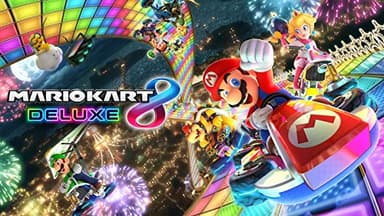
2. How long is the evening? Under ninety minutes, or unpredictable: Mario Kart. A planned night of two hours or more: Mario Party.
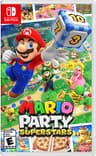
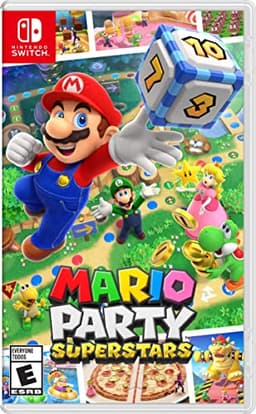
3. Are you all in the same room? If your four are in different houses, Mario Kart online is excellent and Mario Party Superstars is the better Mario Party for online play than Jamboree.
Player counts
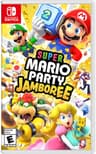
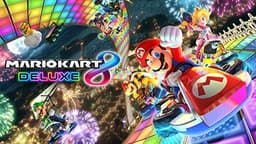
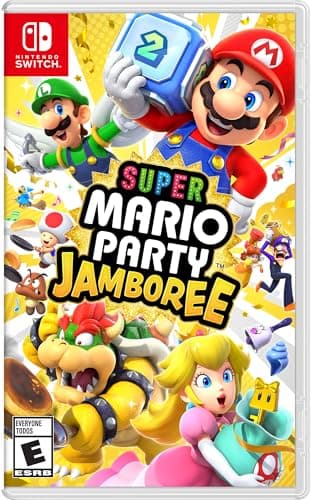
Mario Kart 8 Deluxe handles four players locally in split-screen and up to twelve online. Jamboree is four for the main boards, with some party modes stretching to twenty. Superstars is four locally and online. For a group larger than four in one room, Jamboree is the only one of the three with modes designed for a crowd - though our large groups page has better options for a genuinely big gathering.
Mixed ages and mixed skill
Both handle this unusually well, which is why they are the two default Switch party purchases. Mario Kart's items are deliberately weighted toward whoever is losing, so a child or a non-gamer stays in contention against an experienced player - it is one of the few competitive games we recommend for mixed-skill groups. Mario Party leans on luck even more heavily; the dice do not care how good you are. See games to play with family.
Controllers are the hidden cost
Worth planning for on either: four players means four controllers. Mario Kart can be played with a single Joy-Con each, so a standard Switch with two Joy-Cons covers two players out of the box and four needs one extra pair. Mario Party's minigames often expect motion controls, so shared Joy-Cons are more of a compromise there. Budget for this before you buy the game.
How each one handles people arriving and leaving
This is the practical difference that decides most real game nights. Mario Kart is completely tolerant of it - a cup ends every fifteen minutes, players can swap the controller between races, and someone arriving an hour late has missed nothing. Mario Party is the opposite: a board is a single continuous game with a fixed roster, and a latecomer either watches until it ends or you restart. If your gatherings are loose, that alone settles the question.
Skill, luck, and who wins
Mario Kart is a skill game with heavy luck correction. Better players do win more often, but blue shells and rubber-banding items keep the last-place player within reach, so nobody is ever mathematically out. Mario Party is a luck game with skill flourishes - the minigames reward ability, but the dice, the stars, and the random events can hand victory to whoever played worst. Which of those feels fairer is a matter of taste, and it is worth knowing your group before you buy.
For a group containing a genuinely competitive person and a genuinely casual one, Mario Party's randomness is usually the better leveler - it removes the excuse that the better player deserved to win. For a group that wants to actually get better at something, Mario Kart rewards that and Mario Party does not.
Online play compared
Mario Kart's online is excellent and well populated - twelve-player races, quick matchmaking, and private lobbies for just your friends. Mario Party Jamboree supports online but the format fights it: an hour-long board with four remote players is a long commitment and one disconnection spoils it. This is exactly why Mario Party Superstars is worth considering for a group in different houses; its online support is the strongest in the series. Both games require a Nintendo Switch Online subscription to play online at all, which is a recurring cost worth factoring in.
If you can only buy one
Buy Mario Kart 8 Deluxe. It suits more occasions, needs no commitment, and will get played far more often over a year. Mario Party is the better event, but it is the second purchase, not the first. Both are covered on our Switch page, and the gift guideranks them for buying on someone else's behalf.