Press Start Co

Smash Bros. Ultimate vs Mario Kart 8 Deluxe

Eight players brawling or four players racing?

By Stephen V., Founder & Editor · Last updated August 11, 2026 · How we pick

Head to head

Both Switch party staples side by side, with live Amazon prices. The full breakdown is below.

#GameBest forCrossplayPrice
1
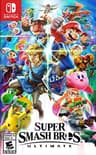
Super Smash Bros. Ultimate cover art
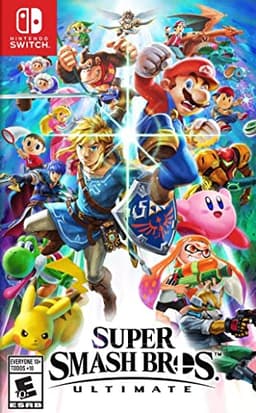
Super Smash Bros. Ultimate
Platform fighter
A Switch crowd that wants an 8-player couch brawl.No - Switch only$54.28
2
Mario Kart 8 Deluxe cover art
Mario Kart 8 Deluxe
Kart racing
A Switch group that wants instant, everyone-can-play racing.No - Switch only$41.99

The short answer: how many people, and how competitive are they?

Buy Mario Kart 8 Deluxe if your group is four or fewer and mixed in experience. Four-player split-screen, no learning curve, and item balancing that deliberately props up whoever is behind. It is the single most useful game a Switch household can own.

Buy Super Smash Bros. Ultimate if you regularly have five to eight people, or if your group likes getting good at things. Eight players locally is a number almost nothing else on any platform can match, and the depth underneath the chaos is enormous.

Both are Switch-only, so if your friends are spread across consoles neither one solves your problem - see the crossplay hub for games that do.

The player-count difference is the real story

Mario Kart seats four locally and up to twelve online. Smash seats up to eight locally, which changes what kind of gathering it serves: with six people in a room, Mario Kart means two of them are watching every race, while Smash means everybody is in.

If your evenings routinely involve more than four people, that alone decides it. Our large groups page covers what else scales that far.

The skill-gap difference decides the rest

Mario Kart is engineered to keep races close. Shells, lightning, and the item distribution all work against the leader, so a first-timer finishes mid-pack and feels fine about it.

Smash does the opposite: a player who knows the systems will beat a newcomer repeatedly and decisively. You can flatten that with items, chaotic stages, and team modes - and most groups should - but the underlying game rewards practice in a way Mario Kart deliberately does not.

For a group with a wide experience gap, that is the difference between an evening everyone enjoys and an evening two people enjoy. Our games for non-gamers guide leans on Mario Kart for exactly this reason.

One to skip

Skip Smash if your group only plays occasionally and hates losing. It is a brilliant game and it is unforgiving about experience gaps. A group where two people played it for years and three people last touched it in 2019 will produce three people who stop picking up the controller. Mario Kart has no such problem, which is why it is the safer purchase for a household rather than a friend group of enthusiasts.

Both games, in depth

1
Super Smash Bros. Ultimate cover art

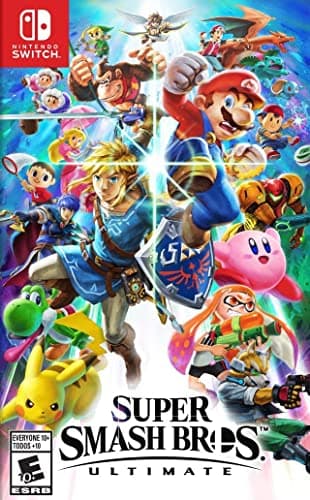
Super Smash Bros. Ultimate

SwitchCrossplay: No - Switch only

Best for: A Switch crowd that wants an 8-player couch brawl.

1-8 local, online · Platform fighter

Up to eight players locally makes this the party fighter for a full room. Deep enough for veterans, button-mash-friendly for newcomers. Switch-only and online can be rough - it shines on the couch.

Facts verified via Nintendo store page.

Also a top pick in Party and Large Groups.

$54.28 · View on Amazon
$59.99-10%
#ad · Price as of September 14, 2026 · Disclosure
2
Mario Kart 8 Deluxe cover art

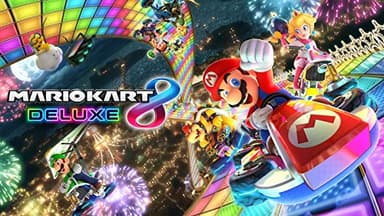
Mario Kart 8 Deluxe

SwitchCrossplay: No - Switch only

Best for: A Switch group that wants instant, everyone-can-play racing.

1-4 local, up to 12 online · Kart racing

The easiest 'everyone grabs a controller' game on Switch - four-player split-screen locally and up to twelve online. Zero learning curve. Switch-only, so it does nothing for a mixed-console group.

Facts verified via Nintendo store page.

Also a top pick in Best Games to Play With Friends and Party.

$41.99 · View on Amazon
$59.99-30%
#ad · Price as of September 14, 2026 · Disclosure

Session length and rhythm

Mario Kart: a race is about four minutes; a full cup is fifteen. It is easy to start, easy to stop, and easy for someone to hand over a controller between races. That makes it ideal for a party where people are also eating, talking, and arriving late.

Smash: a stock match is two or three minutes, which is even shorter, but the rhythm is different - it is a rotation game. With eight people you play, lose, hand over, and wait. Some groups love the tournament feel; others find the waiting deadening.

Controllers, and what each one needs

Mario Kart is unusually forgiving here: a single sideways Joy-Con is a completely viable controller because you only need accelerate, steer, and item. A Switch out of the box covers two players; two more Joy-Con cover four.

Smash is playable on a sideways Joy-Con too, but the button layout is genuinely cramped for a fighting game, and anyone taking it seriously will want a Pro Controller or a GameCube-style pad. Eight players locally also means eight controllers, which is a significant spend on top of the game - budget for it before promising an eight-player night.

Online

Both need Nintendo's subscription for online play, and both let you race or fight friends in other houses. Mario Kart's online is the smoother of the two and takes up to twelve players. Smash's online has always been the weaker part of the package - fine for casual matches with friends, frustrating for anyone who cares about precision.

If your group is spread out and online play matters more than local, Mario Kart is the better buy. If your friends are spread across different consoles entirely, neither works - read Switch + PS5 or Switch + PC instead.

Content and longevity

Smash has the larger package by a distance: an enormous roster, single-player modes, and a level of depth people have been exploring for years. If one person in the group wants something to master, Smash rewards that indefinitely.

Mario Kart's content is deliberately narrower and its replay value comes from the social loop rather than mastery. Both have been supported with substantial extra content - in Mario Kart's case a large paid course expansion, in Smash's case years of added fighters - so neither feels thin.

Which one for which room

Family with a wide age range. Mario Kart. It is the most inclusive multiplayer game Nintendo makes - see family games.

Six friends who all play games. Smash. Everybody is in, and the rotation is part of the fun.

A house where people drop in. Mario Kart. Nothing needs explaining.

A regular fight-night crew. Smash, easily.

Buying a gift for a Switch owner. Mario Kart, unless you know they already have it - see our gift guide.

If you can only buy one

Buy Mario Kart 8 Deluxe. It is the more universally useful of the two, it works with any group you put in front of it, and it is the one that still gets played five years later by people who do not consider themselves gamers. Smash is the better game for enthusiasts and the worse party purchase for a mixed room.

Live prices for both are in the table above. Full write-up of the winner is in our Mario Kart 8 Deluxe review, and the Switch pageranks both against the rest of the console's multiplayer library.
Frequently asked questions

Smash Bros. or Mario Kart for a group of friends?+

Mario Kart 8 Deluxe for four or fewer players with mixed experience, because the item balancing keeps races close. Super Smash Bros. Ultimate if you regularly have five to eight people in the room or your group enjoys mastering a game.

How many players does each support?+

Mario Kart 8 Deluxe seats four locally and up to twelve online. Smash Bros. Ultimate seats up to eight locally, which is one of the highest local player counts on any console.

Which is better for beginners?+

Mario Kart, clearly. Smart steering keeps new players on track and the items help whoever is behind. Smash rewards practice, so an experienced player will beat a newcomer consistently.

Do either of them have crossplay?+

No. Both are Nintendo exclusives with no versions on other platforms, so a group split across consoles cannot use either one.

How many controllers do you need?+

One per local player. A Switch ships with a pair of Joy-Con that split into two controllers. Mario Kart plays fine on a single sideways Joy-Con; Smash is cramped that way, and an eight-player session needs eight controllers.

Which has the better online play?+

Mario Kart. It supports up to twelve players and runs more smoothly. Smash's online has always been the weakest part of the package, though it is fine for casual matches with friends.