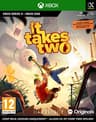
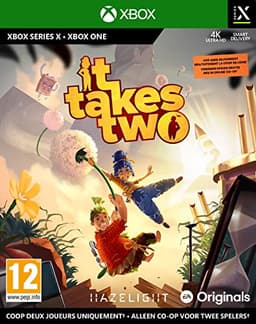
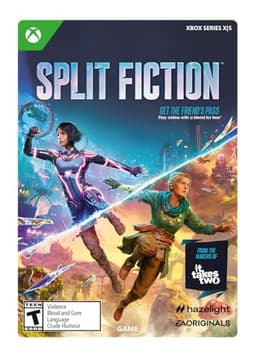
Decide in three questions
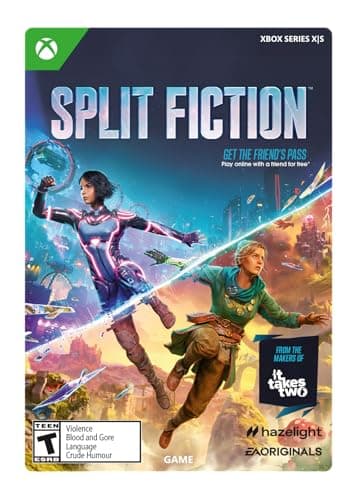
1. Are you both on the same platform? If no, buy Split Fiction and stop here. If yes, continue.
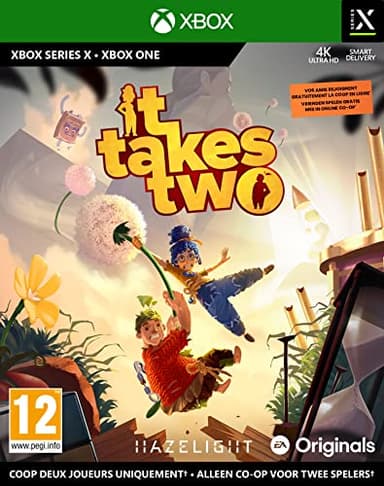
2. Have either of you played It Takes Two? If yes, buy Split Fiction - it is the closest thing to more It Takes Two that exists, and our games like It Takes Two page explains why nothing else comes as close. If no, continue.
3. Which is cheaper right now? Genuinely - they are close enough in quality that price is a reasonable tiebreaker. Both routinely discount.
The Friend's Pass, and why one copy is enough
Both games let one player buy and the second join free for the entire campaign, with no time limit or reduced content. The difference is reach: It Takes Two's pass keeps the second player on the same platform family, while Split Fiction's works across platforms because the game has crossplay. For a long-distance pair on different systems, Split Fiction is therefore the only one of the two that works at all - see games to play with your partner.
Local play: both are identical here
On one couch with one console, both games behave the same - one copy, two controllers, permanent split-screen, no crossplay question to answer. If that is your setup, ignore the crossplay difference entirely and pick on price or setting. Our split-screen page covers the format across other games.
Length and replay value
Both are designed arcs of roughly a dozen hours with a clear ending, and neither has meaningful replay value - you finish them and move on. That is not a criticism; it is why they stay consistently inventive. But if you want something to return to weekly, neither is the right purchase, and Stardew Valley or Minecraft would serve better. See our 2-player list for that comparison.
Difficulty and who you can play them with
Both games are deliberately forgiving. Neither has a difficulty setting, because neither needs one - deaths are cheap, checkpoints are frequent, and the design goal is that you keep moving forward together rather than that you are tested. That is the reason both work so well with a partner who rarely plays games, and why they turn up on our co-op for couples page as well as the co-op hub.
The asymmetry does something subtle here that is worth spelling out. Because each player holds abilities the other does not, an experienced player literally cannot reach over and do the hard part. In a conventional co-op game they usually can, and often do, which is how a beginner ends up following someone around holding a torch. Neither of these games allows that failure mode, and it is the single strongest argument for buying either over a generic four-player co-op title.
What neither game does
Neither has a competitive mode, a level editor, post-launch seasons, or any reason to reinstall once the credits roll. Neither supports three players. Neither has a solo mode. If any of those matter to you, both are the wrong purchase and the co-op hub covers games that scale and persist - Deep Rock Galactic and Helldivers 2 for a squad, Minecraft or Terraria for something that never ends.
A note on price and when to buy
Both discount regularly rather than sitting at full price forever, and because only one of you needs a copy, the effective cost per player is already half what the sticker suggests. The prices in the table above come live from Amazon and move week to week, so check them rather than relying on a figure you remember. If budget is the deciding factor rather than platform, our cheap picks pagehas two-player options at a fraction of either game's cost - Portal 2 in particular.
Full reviews
We have written both up individually if you want more detail: It Takes Two review and Split Fiction review. For the wider field of two-player games, see the 2-player list; for everything that resembles these two, see co-op games like It Takes Two.